
The BRAVA project, a Clean Hydrogen Partnership-funded initiative, has successfully transitioned from its development phase into its final activity phase. In fact in this last half year in all WPs the major tests will be done, which have been long time prepared.
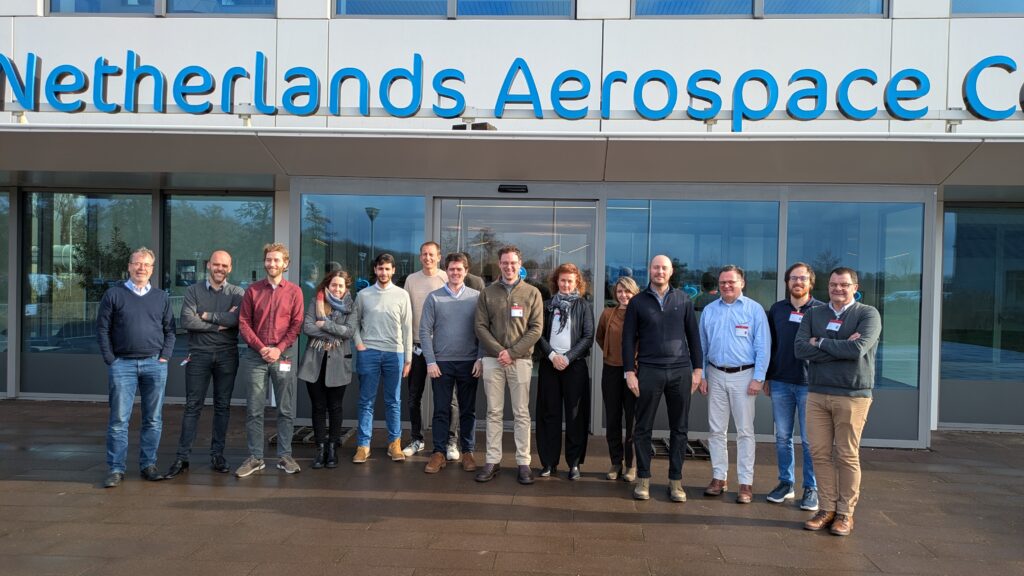
On the 10th to the 11th of February the last working consortium meeting was held in Marknesse at the NLR facility in the Netherlands. The partners could witness the operating two phase cooling system at 240 kW. It proves the critical shift away from standard glycol-water coolants to a pioneer two-phase methanol-based cooling system.
 Also the consortium was able to watch the parallel running environmental qualification tests at NLR according to DO160, like salt spray and vibration, for the 3D printed heat exchangers. In this activity the next step is to finalize the manufacturing of the 200 kW heat exchanger by the partner Madit and move this to NLR to do the performance test on the modified 200 kW test rig. The integration of a 3D-printed metal air-cooled heat exchanger, combined with the removal of the humidification system from critical stack sections, resulted in a propulsion system that is significantly lighter and
more compact. Crucially, these weight savings are achieved without compromising durability, thereby bringing the aviation graded fuel cell system much closer to operational flight readiness. Furthermore, the state-of-the-art air compressor, which had faced assembly delays in 2025 due to long lead times, is now fully integrated and functional and is undergoing the neede
d performance mapping and as well qualification tests also according to the DO160, like vibration and pressure test.
For the fuel cell MEA development itself the team faced in the last period the complex challenge of scaling up next-generation catalysts and membranes while maintaining a rigorous 20,000-hour operational lifespan. While small-scale catalyst materials showed early promise, the transition to full-scale production required significant refinement to meet aviation standards.The first test on small scale stack proved this low performance. In the remaining time, the latest improvements for the catalyst, ionomer and membrane will be integrated into the last MEA for a last small scale stack. By early 2026 the test data will be available and will show if the technical ambitions were fully realized through several key innovations as anticipated by the consortium.
In summary, following a series of technical hurdles and ambitious scaling targets identified in mid-2025, the multi-national consortium has confirmed the successful completion of all seven primary project milestones, bringing it closer to low -emission flight. Looking ahead, the BRAVA project is preparing for its Final Event in June 2026. This gathering will serve as the primary platform for the project’s exploitation strategy, showcasing how BRAVA has pushed the boundaries of fuel cell technology to lay the groundwork for a cleaner, greener future in global air travel.